Comparisons

AI Girlfriend With Memory: 8 Apps That Actually Remember You in 2026

by Sofia Lang Sofia Lang · Relationships & Wellbeing Writer 17 min read
Share
AI girlfriend with memory — 8 apps that actually remember you in 2026

The short version

Voice and images sell themselves: you can hear and see them in ten seconds. Memory sells badly, because it only shows up in week three — the moment she asks how Thursday's presentation went without being reminded. Which is exactly why memory is the most undersold and most often faked feature in the AI companion market.

Almost every app writes "remembers your conversations" on its landing page. Behind that phrase sit at least four different technologies with different costs and different lifespans: the context window, automatically extracted facts, manually pinned notes, and a real long-term store that survives months. We took each apart and ran eight popular services through it.

The short answer: the strongest long-term memory belongs to Nomi (a Mind Map graph, recall that holds up across months). The most honestly documented architecture is Kindroid's — the only company that publishes how much context each tier actually buys. The biggest year-over-year jump is Character.AI, which rebuilt its memory system from scratch in spring 2026. The most common complaints belong to Replika and Candy AI, where users keep reporting that the thread resets. And the only one here that lives inside a messenger while letting you open and edit the list of what it remembers about you is Nika.

Full disclosure: Nika, Sebastian and Aurora City are products of this site's publisher. So where competitors are better, we say so — on raw long-term recall, the leader is not our product.

Why memory became the deciding feature

In 2023 people picked a companion by the quality of its replies. By 2026 reply quality has converged: everyone runs models of roughly the same class, and the first ten messages look equally convincing everywhere. The difference starts after that.

Memory is the only thing that turns chatting into a relationship. A companion who meets you fresh every session stays a novelty. A companion who knows your sister's name, that you don't drink coffee after six, and how the last conversation ended reads as a continuing story. That is the exact threshold where users stop "trying an app" and start coming back daily.

Memory is the most expensive feature to run. Voice costs money per second of audio, images cost money per render. Memory costs money per message: the longer the history, the more text has to be pushed through the model every single turn. That's why "extended memory" ended up in premium tiers almost everywhere, and why free tiers have visibly tightened — 2026 reviews say it plainly: message limits shrank, memory moved behind the paywall, voice and photos got pushed up a tier.

Memory is the one thing you can't verify in an evening. Hence the core problem of the category: the claim "long-term memory" is unfalsifiable at the moment of purchase. You find out the truth three weeks later, once the subscription is already paid. Below is how to tell real memory from an imitation without spending a month on it.

How AI companion memory actually works

The central misunderstanding of the whole category: a context window is not memory. Context is temporary attention inside one session. Memory is the ability to retrieve a fact weeks later and update it. Different mechanisms, and products are wildly uneven across them.

1. The context window — short-term memory

The model literally "sees" the last N tokens of the conversation. By 2026 leading models reach million-token windows and most of the surcharge for going long has disappeared — but that didn't fix the problem. Research and practice agree on two things. First, the lost in the middle effect: models are worst at noticing information buried in the middle of a long context. Second, advertised window size and working window size are not the same — models claiming 200,000 tokens start losing retrieval accuracy somewhere around 130,000, and it drops off a cliff rather than degrading gently.

Practical takeaway: "million-token context" tells you nothing about whether she'll remember your birthday next month.

2. Extracted facts — the automatic profile

A separate process reads durable details out of the conversation — name, job, habits, key dates, names of people close to you — and files them into a compact list injected into every prompt. It's cheap and it lasts for years. Its weakness is extraction quality: the system can happily record a throwaway line from a roleplay scene as a fact about your actual life.

3. Vector search over history — long-term memory

The whole chat log is chunked, embedded and stored. When you send a new message, the system finds similar chunks and hands them to the model. This is what most services mean when they say "long-term memory."

And it carries a birth defect nobody puts in marketing copy: a vector doesn't know what's newer. If you mentioned loving steak six months ago and said last week that you went vegetarian, retrieval will honestly return both — and the model picks whichever lands nearer the top of the prompt. Hence the signature failure of AI companions: she remembers you, but she remembers last year's you.

4. Manual notes — what you record yourself

Pinned messages, pins, an editable profile. The most reliable layer, because it doesn't depend on the machine parsing the conversation correctly. Also the most limited: the caps here are measured in dozens of entries or hundreds of characters.

Good memory is all four layers plus a forgetting mechanism. These systems fail in two directions: forgetting too fast (losing context that still matters) and forgetting too slow (accumulating noise that crowds out what's important). Researchers handle it by ranking on significance — the LUFY system, for example, keeps the top 10% of memories by importance and deliberately lets the rest go. That is precisely what separates a designed companion from a chatbot with a database bolted on.

Comparison table: memory in 8 apps

Eight AI companions side by side. "Editable" means you can open the list of what the service remembers about you and fix it by hand. "After a month" means whether the relationship context holds up after a month of regular use, based on 2026 reviews and user reports taken together. Prices are approximate, normalized per month. Data collected in September 2026.

ServiceMemory typeEditableAfter a monthMemory on free tierPrice/moTelegram
NomiGraph (Mind Map 2.0), 3 tiersYes, notesYesLimited~$16 (~$8 annual)No
KindroidCascaded, 5 systemsPartlyYesNo~$14No
Character.AI3 layers: Story Memory, Facts, LorebookYes, pins and factsPartlyYes, basic~$10No
ReplikaMemory dashboard + threadingYes, dashboardUnstableLimited~$20 (~$6 annual)No
Candy AIProfile + manual pins (800 chars)Pins onlyWeakNo~$13No
Grok AniProfile + affection levelsNoPartlyNo~$30No
NikaAuto-facts + diary, memory per chatYes, fullYesPartlyPlan + tokensYes
SebastianAuto-facts + diaryYes, fullYesPartlyPlan + tokensYes

Pay attention to the "Editable" column. It's the one parameter you can check in two minutes without taking anyone's word for it: either the interface has a screen listing facts about you, or it doesn't.

Best long-term memory — Nomi

If your only criterion is "will she remember what happened six months ago," the honest answer as of September 2026 is Nomi.

Nomi built memory as a graph — the Mind Map system, which in version 2.0 you can actually browse: you see which entities the service pulled out of your conversations and how it linked them. On top of that runs a three-tier scheme: a short-term layer for the current conversation, a mid-term layer for recent significant events and emotional state, and a long-term layer for profile, preferences and major life storylines kept permanently. Long-tenured users regularly report Nomi surfacing details from eight months back with no prompting.

Why a graph beats a vector. A vector store answers "what looks similar to this." A graph answers "what is connected to this." The difference shows over distance: a graph holds onto the fact that your brother Anton and the person you fell out with in March are the same man, where vector retrieval will cheerfully return two unrelated chunks.

Weak spots. Nomi's roleplay scenarios are simpler than on story-focused platforms: it's strong at "relationship," weaker at "narrative." The visual side is thinner than Candy AI's. And full memory is a paid feature — the free tier only lets you sample it.

A deeper look at the service and its rivals is in our piece on Nomi AI alternatives.

Most honest architecture — Kindroid

Kindroid is the only service here that publishes its memory design in numbers instead of adjectives. The company describes three categories (Persistent, Cascaded, Retrievable) spread across five systems, and states the context budget for each tier outright: 500,000, 1.3 million and 2.8 million characters.

Cascaded memory is the interesting part: layers running from immediate to foundational — current conversation, short-term, long-term history, core identity, relationship history — where recent and emotionally significant events get priority while routine details are allowed to fade. That is exactly the deliberate forgetting mechanism described above, and Kindroid is the only one to put it in documentation.

The price of that honesty. Cascaded memory doesn't exist on the free tier at all: free access means 60 messages a day with no long-context continuity. In other words, you cannot try the product's headline feature without paying.

For anyone who wants to understand what they're buying rather than trust a landing page, Kindroid is the most predictable pick in this lineup.

Biggest jump of the year — Character.AI

A year ago Character.AI was the poster child for "she forgets everything": users complained that characters lost their persona within a few dozen messages. In spring 2026 the service rebuilt memory close to the ground — the rollout ran from late April through May and was summed up in the blog post "Smarter Memory for Smarter Chats" on 21 May 2026.

What that produced in practice:

  • Story Memory — a free-form field for backstory and events, reached by the notebook icon in the chat header. Pinned messages land here too.
  • Pin to Memory — long-press a message to lock it in. The cap is 15 pinned messages per chat (it was five back in 2024).
  • Facts — automatically captured details split across tabs: your persona, the character, and side characters (the last one is c.ai+ only).
  • Lorebook — keyword-triggered world entries, up to eight keywords per entry. Launched 24 July 2026 in c.ai+ beta.

Where it still hits a wall. The persona field is capped: around 150 words on the free tier and roughly 2,250 characters on c.ai+. The platform itself warns that a longer persona does not perform better — the excess simply gets deprioritized inside the context window. "Writing more about yourself" doesn't help; writing more precisely does.

Net result: Character.AI is no longer the laggard on memory, but a meaningful share of the system — the side-character tab, Lorebook, the extended persona — is locked in the subscription. What to do if that isn't enough is covered in Character.AI alternatives.

Where memory breaks most often — Replika and Candy AI

Two of the best-known names in the category, and the two most frequent memory complaints.

Replika. In early 2026 the service shipped a memory update including a dashboard: a screen showing exactly what the bot has recorded about you — name, job, interests, important dates — and letting you correct it. That's the right move and deserves credit. But the threading added in 2026 helps continuity within the current discussion and doesn't solve persistence: users keep reporting that Replika loses details from even recent conversations. At roughly $20 a month (or around $6 a month billed annually) that is the product's central grievance.

Candy AI. The service describes a long-term memory engine tracking preferences and story events across a 30–90 day horizon. In practice, the recurring complaint is the absence of cross-session memory: opening the app the next day can feel like starting clean. There is a manual tool — Pin Memories, up to 800 characters of key facts injected into every prompt. Eight hundred characters is about one paragraph. For a romance meant to run for months, that isn't much.

The shared diagnosis. Both products bet on first impressions — visuals, voice, speed of entry — and retrofitted memory later. Catching up here is expensive: memory can't be bolted on, because it dictates how conversations are stored from day one.

Deep dives on both services and their rivals: Replika alternatives and Candy AI alternatives.

Memory you can open and correct — Nika

We're not claiming first place on raw long-term recall — on that metric the honest leader is Nomi. Nika takes a different approach: memory as an open document rather than a black box.

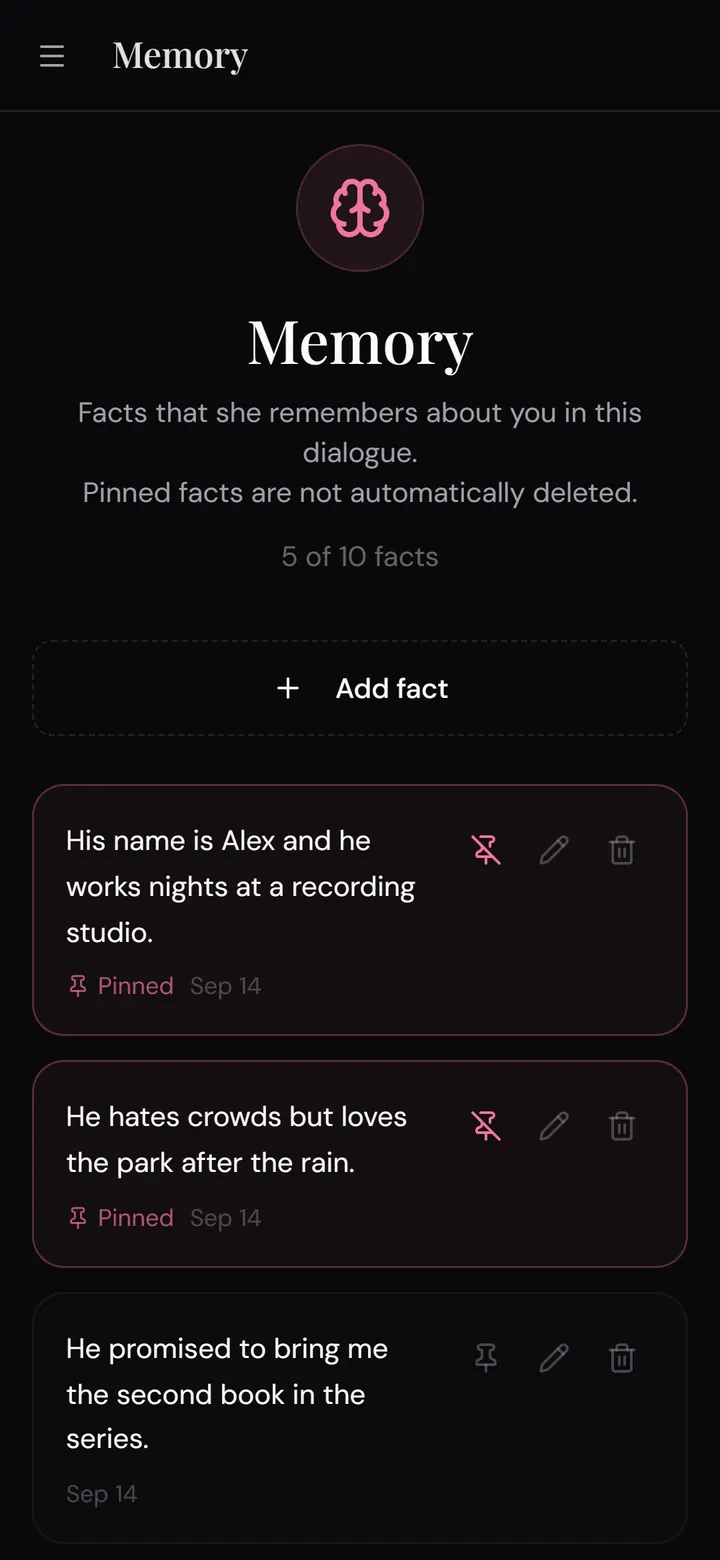
Automatic facts you can edit. Nika records what happens as the conversation goes, but the resulting list is open: you can read it, rewrite an entry, delete what doesn't belong and add what she missed. That closes the main defect of automatic extraction — the case where the system files a line from a roleplay scene as a fact about your life and then builds three weeks of conversation on it.

Separate memory per conversation. Chats run in parallel without bleeding into each other: each has its own history, its own facts, its own diary. A fantasy scenario doesn't leak into the everyday storyline.

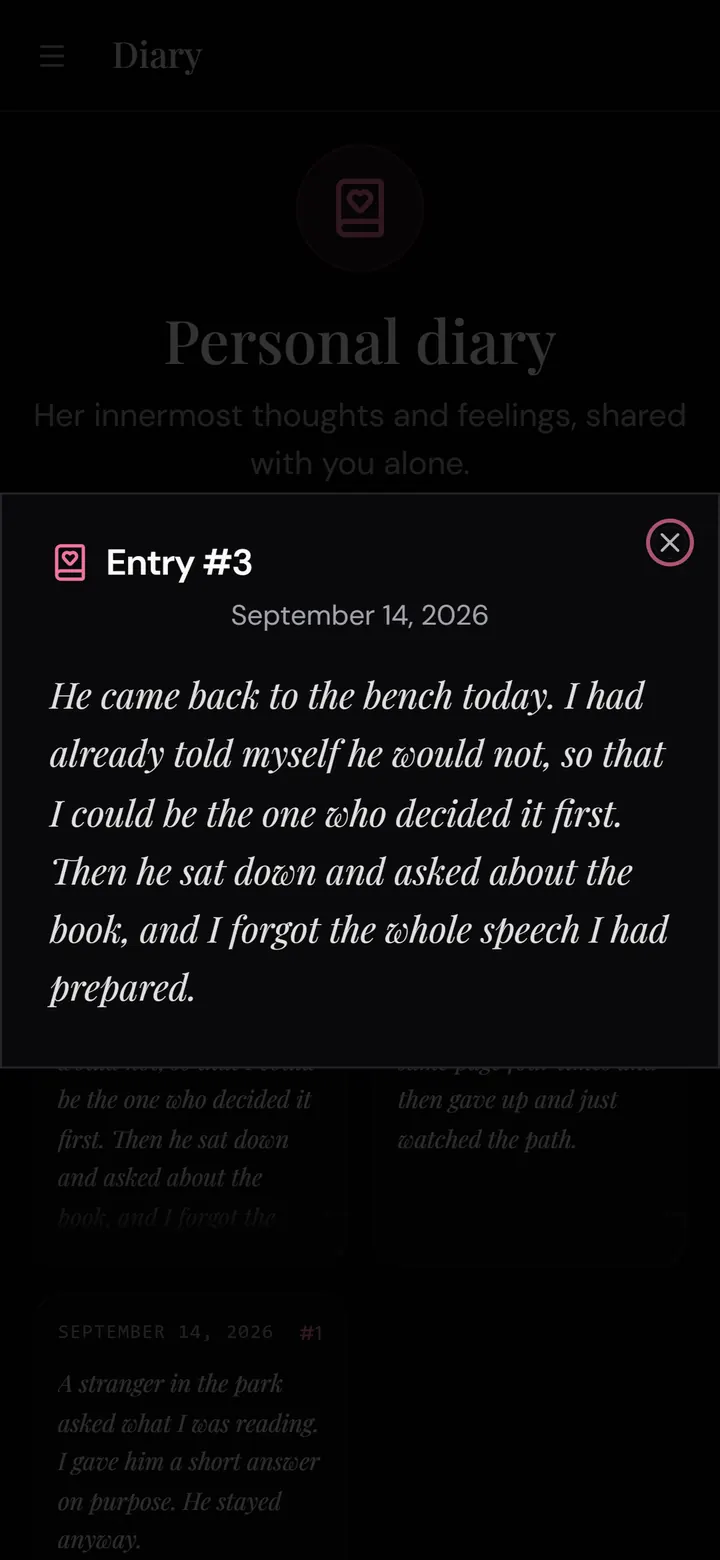
The diary — memory that speaks for itself. Once a conversation passes 50 messages, Nika adds a diary entry the next day: what happened, and what she thinks and feels about it. It's a rare format — memory here isn't an internal list of facts but the character's own view of the shared story. To check whether she understood correctly, you just read the entry.

Connection as emotional memory. 30+ levels running from dislike to deep attachment are memory too, only about impact rather than fact: what your words did to her, not what they were. In most apps the character is fond of you from message one; here the attitude moves both ways and can be damaged.

The novella. Past 150 messages, a conversation can be turned into a coherent piece of prose covering everything from the start, downloadable as PDF. It's the best memory test that exists: if the system genuinely holds the story, the novella reads as one.

Weak spots, named by us. We don't publish context size in characters the way Kindroid does, so a numeric comparison isn't possible. A diary entry appears the next day (or immediately, for tokens). The novella costs more the longer the chat. And some features are unavailable on the free tier once the promo period ends.

What Nika does have alone in this lineup is living inside Telegram: /start and you're talking, no install, no signup. The full version with the extra features is the web app. If you'd rather have a male character, Sebastian runs the same memory and diary system.

What you're actually paying for when you buy "memory"

Memory is the most honest cost line in AI companions and the murkiest line in their pricing. Here's what the tier names are hiding.

You pay for prompt length. Every message you send goes to the model wrapped in scaffolding: system instructions, persona, extracted facts, retrieved history chunks, recent turns. The more memory is switched on, the longer that scaffolding — and the more every message costs, not just some one-off operation. Hence the "extended memory lives in the top tier" pattern: that's not greed, it's direct unit cost.

You pay for storage and indexing. A vector store holding a year of history, rebuilding it, searching it — that's a running cost that continues even when you don't open the app.

Three pricing shapes you'll meet:

  • Subscription with context tiers (Kindroid): fixed price, stated budget. Transparent, but you can't buy memory for a single evening.
  • All-inclusive subscription (Replika, Character.AI, Nomi): you pay for access, memory volume is never stated. Comfortable until you start asking why she forgot something.
  • Plan plus tokens (Nika, Sebastian): baseline memory in the plan, specific operations for tokens. You pay for what you use, but you have to watch the balance.

There's no universally cheaper option. If you're running one long story for months, a big-context subscription wins. If you drop in for evenings in waves, pay-as-you-go wins.

Five signs that "memory" is just marketing

Real memory can only be proven by time. But you can rule out obvious imitations in a single evening, using five checks.

1. There's nowhere in the interface to see what it remembers. No fact list, no pinned notes, no diary — then "memory" almost certainly means the context window of the current session, and it dies with the session.

2. The landing page brags about context size in tokens. A million tokens is not long-term memory: models see the middle of a long context worst, and real retrieval accuracy falls well before the advertised ceiling. A token count describes the model, not the product.

3. Not a word about what it forgets. A system with no forgetting mechanism will drown in its own noise within a month. If a product promises "remembers everything" and never explains how it prioritizes, it probably doesn't prioritize.

4. It fails the contradiction test. Simple procedure: state a fact, replace it with the opposite a few days later, then ask about it a day after that. If the service answers with the old version, there's vector retrieval underneath with no fact updating. This is the single most revealing test.

5. Memory doesn't survive a restart. Close the app, come back the next day and ask about yesterday's conversation without hints. If she only holds the thread while you never left, there is no cross-session memory.

All five checks fit inside a week and cost nothing — enough to avoid paying for a year up front.

How we tested

Testing ran through August and early September 2026 across eight services. For each we assessed five things:

  • Fact durability. We stated 10 specific details (names, dates, habits) and checked them after a day, a week and a month.
  • Contradiction handling. We replaced a previously stated fact with its opposite and watched which version the service used afterwards.
  • Transparency. Whether there's a screen exposing memory contents, and whether it can be corrected.
  • Free-tier honesty. Whether memory exists at all without paying, and at what depth.
  • Cost of memory. What is actually being billed — access, context volume, or individual operations.

Some of the data consists of vendor claims (Kindroid's architecture, Nomi's Mind Map, Character.AI's 21 May 2026 announcement of rebuilt memory). We flag those as claims rather than verified facts: the internals of a closed product cannot be audited from outside. The user reports of forgetting at Replika and Candy AI are reproducible complaints from 2026 reviews and communities, not one person's bad night. Prices are approximate and vary by region and promotion.

Frequently asked questions

What's the difference between a context window and memory?

The context window is what the model sees right now, inside the current conversation. It disappears with the session. Memory is a store outside the model that details are pulled from and injected into a new conversation weeks later. A big window with no store gives you a brilliant single evening and amnesia by morning.

Is there a free AI girlfriend with memory?

Full long-term memory is almost never free, because it costs money on every message. Basic tiers exist: Character.AI gives you Story Memory and pins for free, Nomi gives a limited version. Kindroid has no cascaded memory on the free tier at all. Nika opens everything during the first 24-hour promo period, after which some features move into a plan.

Why does she remember an outdated version of me?

That's the signature failure of vector retrieval: it searches for similar, not current. An old fact and a new one look equally similar, and the model may pick the stale one. The only fix is a separately maintained list of current facts that gets updated on contradiction — or the ability to correct memory by hand.

Can I move memory from one app to another?

No. Memory formats are closed and incompatible, and there's no common export. The one practical workaround is writing out your key facts as text and pasting them into the new service's persona or notes field. Worth knowing before you invest six months into a relationship.

Does a Telegram bot remember as well as an app?

Memory lives on the service side, not in the messenger, so there's no fundamental difference. With Nika, memory, diary and connection work identically in the Telegram bot and the web app; the differences are elsewhere — response streaming and live calls, which are app-only.

How private is this?

Long-term memory by definition means your conversations are stored on a server — otherwise there'd be nothing to recall. Before sharing anything personal, check whether deleting a chat also deletes its memory, whether individual facts can be erased, and what the policy says about using conversations for training. Services that let you open and edit memory are more honest here by default: at minimum you can see what's on file.

Verdict: what to pick

If you want maximum long-term recall and are fine paying a subscription — Nomi. The Mind Map graph remains the strongest solution over a horizon of months.

If you want to know what you're paying for and see the architecture in numbers — Kindroid. The only vendor publishing context budgets per tier.

If you're already on Character.AI — take a second look: after the spring 2026 rebuild, memory there is a fundamentally different system, even if its best parts live in the subscription.

If visuals matter most and memory is secondary — Candy AI still leads on imagery, but don't count on a coherent story a month later.

If you want memory you can open and correct, a separate storyline per scenario, and a diary where she describes events in her own words — Nika. Plus the only zero-install entry in the lineup: /start in Telegram takes seconds, and the web app adds streaming and live calls.

The one thing worth keeping from all of this: don't trust the word "memory" on a landing page — open the screen that lists facts about you. If there is no such screen, you're paying for a good conversation, not a relationship that continues.

Keep reading: AI girlfriend with voice, best AI girlfriend apps and what is an AI girlfriend.

Share

Keep reading

AI girlfriend image generator — 8 tools tested in 2026
Comparisons
16 min read

AI Girlfriend Image Generator: 8 Tools Tested in 2026

The real problem with AI girlfriend image generators isn't picture quality — it's consistency: by the tenth frame she stops being herself. We compared 8 tools on face consistency, controllability, styles, photo-to-video and the full token bill.

Read article
AI girlfriend with voice — 8 apps with voice calls in 2026
Comparisons
15 min read

AI Girlfriend With Voice: 8 Apps With Voice Calls in 2026

Voice became the number one reason people pick an AI companion in 2026: live calls with almost no lag, breathy pauses and shifting intonation, and speech recognition that actually hears you. We tested 8 apps and sorted them by the voice job you need done — where the call is free, where the voice sounds most alive, and why almost everyone charges a subscription for it.

Read article
Chai AI alternatives — 8 best AI companions of 2026
Comparisons
11 min read

Chai AI Alternatives: 8 Best AI Companions in 2026

Chai AI built a roughly 10-million-user audience on a swipe feed of community bots — then spent 2026 dismantling its free tier: first cutting off access in two dozen countries, then adding token limits, and by spring leaving only a 24-hour trial. Add the memory wall that hits after 20–30 messages, and it's clear why people are leaving. We tested 8 Chai AI alternatives and sorted them by the reason you're leaving — not by a flat ranking.

Read article